Trinity SundayB, May 31, 2015
June 2, 2015
Our Eternal-Life Coach
John 3:1-17
3:1 Now there was a Pharisee named Nicodemus, a leader of the Jews. 2 He came to Jesus by night and said to him, “Rabbi, we know that you are a teacher who has come from God; for no one can do these signs that you do apart from the presence of God.” 3 Jesus answered him, “Very truly, I tell you, no one can see the kingdom of God without being born from above.” 4 Nicodemus said to him, “How can anyone be born after having grown old? Can one enter a second time into the mother’s womb and be born?” 5 Jesus answered, “Very truly, I tell you, no one can enter the kingdom of God without being born of water and Spirit. 6 What is born of the flesh is flesh, and what is born of the Spirit is spirit. 7 Do not be astonished that I said to you, ‘You must be born from above.’ 8 The wind blows where it chooses, and you hear the sound of it, but you do not know where it comes from or where it goes. So it is with everyone who is born of the Spirit.” 9 Nicodemus said to him, “How can these things be?” 10 Jesus answered him, “Are you a teacher of Israel, and yet you do not understand these things? 11 “Very truly, I tell you, we speak of what we know and testify to what we have seen; yet you do not receive our testimony. 12 If I have told you about earthly things and you do not believe, how can you believe if I tell you about heavenly things? 13 No one has ascended into heaven except the one who descended from heaven, the Son of Man. 14 And just as Moses lifted up the serpent in the wilderness, so must the Son of Man be lifted up, 15 that whoever believes in him may have eternal life. 16 “For God so loved the world that he gave his only Son, so that everyone who believes in him may not perish but may have eternal life. 17 “Indeed, God did not send the Son into the world to condemn the world, but in order that the world might be saved through him.
I’ll be preaching three more sermons here after today. I spent some time last week trying to think of some way to wrap up my preaching tenure in some kind of coherent package or series of sermons. I tried, but I failed. In fact trying to come up with a comprehensive preaching plan all but put me in a fetal position. I’ve never been able to construct a series of sermons and I’m certainly not equipped to do that when you enter the additional factor of departure emotions — and I’ve got a few of those floating around in my gut.
This is not a particularly calm moment in my life. I expect to become a grandfather sometime within the next few weeks. I’ll be moving from the house I’ve been living in for the last nineteen years in about a month, and my daughter and her husband will be moving to Kansas City in about two months and I understand they will be taking our grandchild with them. And within that profound mix of emotions I’ve got some feelings for this church that I’ve been fully engaged with for the past six years.
In all honesty, I’m a mess right now. I’m not a terrible mess, but I’m emotionally all over the place! I’m feeling a lot of loss and a lot of love these days. But I’m also enjoying the status of a short term pastor – which is to feel the release of some responsibility. I haven’t been able to fix everything, but it’s basically too late – the time has come for me to distribute my current set of problems to other people. I’ll be getting a new set of problems soon, but I’m enjoying the bliss of ignorance for now.
So don’t count on a coherent series of sermons from me over the next few weeks, but I plan to be here. I’ll find something to talk about, and you can count on Jesus being here – Jesus always seems to be on hand during a crisis.
I actually feel some kinship with Nicodemus right now. Nicodemus showed up to speak to Jesus at night, and there are a number of ways in which I feel like I’m in the dark. I can’t really see what’s going on. Some people think this Nicodemus character embodied darkness – someone who chose to remain in the dark, but I have a more sympathetic reading of Nicodemus. I don’t think of him as someone who loved the darkness as much as I see him as someone who found himself in the dark and wasn’t quite sure how to get out of it.
These Jewish authorities are portrayed as pretty horrible people, and they earned that reputation, but like most people who find themselves operating in hellish systems, he didn’t set out to be an enemy of the son of God. He didn’t go in to that line of work because he wanted to be spiritually ignorant. I dare say he was well motivated to become a Pharisee – it’s probably what all the sharp-minded conscientious young people of his day wanted to become.
Nicodemus didn’t find himself within the community of people who rejected Jesus because he had decided to resist the work of God in the world. He was a man who had gotten caught up in something he didn’t fully understand. He was in the dark – he didn’t know what to do, but he didn’t feel very good about what he was doing.
I don’t feel like I’m in as dark of a place as Nicodemus was. I’m happy to say I don’t feel like I’m collaborating with people who are plotting to kill the embodiment of God on earth, but I am in the dark in some significant ways. To use the metaphor that Jesus used – maybe I’m feeling a little bit like I’m in the position of a baby who is yet to be born. It’s dark and I don’t really know what’s going on, but I feel like something is about to happen. And something needs to happen – I’m not in a position that I can remain in for much longer.
My soon to be born granddaughter and I have a lot in common. I’m between worlds. I’m not sure what the new one will look like, but as surely as nature takes it’s course, the institutional wheels are turning, and I’m about to find myself living in a whole new environment. Which isn’t all bad, but there are a lot of unknowns.
I’m feeling it, and many of you are feeling it as well. Whether it’s the transition that the church is undergoing or your own personal transition that’s taking place I don’t think it’s an uncommon feeling to be in the figurative dark. This is a hard world to navigate, and it’s not unusual to not know what is about to happen or what needs to happen. Nicodemus may not have shown up with the right set of expectations for what was needing to happen, but I give him a lot of credit for showing up to engage in a conversation with Jesus. He may have come to him in the dark of night, but he didn’t have to show up at all, and that indicates to me that he was at least trying to find his way.
I attended a clergy training event about a week ago, and as strange as this may sound I actually got something out of it. I can’t say that about all of the training events I attend, but this was a two-day event that took place at Mt. Eagle Retreat Center – which is a retreat center that sits on a bluff overlooking the headwaters of the Little Red River. I’ve said this before, but the place is misnamed. Instead of calling it Mt. Eagle, they should have named that place after the buzzards that like to soar above the bluffs that are along one border of the property. A buzzard may not be much to look at up close, but they fly beautifully and you are far more likely to see a buzzard than an eagle at Mt. Eagle. I don’t want to make too much of the biologically inappropriate name of that place, but I think it points to a problem that often plagues religious organizations – which is the aspiration to be considered awesome.
Eagles are awesome. Buzzards are common. And while there is something awesome about what Jesus had to teach, the kind of awesomeness that Jesus taught is not the kind of awesomeness that goes viral on the internet. It’s not the kind of awesomeness that the Pharisees could appreciate. They wanted to create the kind of religious organization that would impress the crowds and gain the respect of powerful people, and that’s not what Jesus was up to. Jesus didn’t want to create a new kingdom on earth — Jesus wanted to help people find their way in to the kingdom that already existed.
Jesus was more of a buzzard than an eagle. He didn’t want to impress people with his awesomeness – he wanted to be seen for who he was, and he wanted people to see through the façade of false faith. Jesus undermined the official community of God as it existed in Israel because he wanted people to understand what the kingdom of God actually looked like. And that’s why Jesus told Nicodemus that he needed to be born again. Nicodemus had been drawn in to the religious community of the Pharisees because he liked the idea of participating in God’s community, but he couldn’t see how dark that community had become. The conversation between Jesus and Nicodemus was strained because Nicodemus had been trained by his peers to love and to promote the wrong things.
The training event I attended introduced me to the concept of approaching ministry with the skills of a life coach. And while the language of life-coaching may sound a little first-worldly or high falootin, but the truth is that the skills we were taught are applicable on every level of human interaction. The primary skills of life coaching are the skills of listening and asking questions. The primary objective of a life coach is to elicit from another person the knowledge that they already have. A good life coach is not someone who imparts wisdom but who motivates people to lay claim to what they already know.
It strikes me that this interaction between Jesus and Nicodemus was a profound life-coaching session. Nicodemus didn’t really know what he was wanting to say to Jesus, but Jesus heard him express interest in the kingdom of God. Jesus didn’t employ the classic technique of a life coach and ask him questions that might help him understand what he was wanting, but then Jesus wasn’t a certified life-coach – Jesus was a renegade life-coach. Jesus wasn’t out to help people improve their lives on earth – Jesus wasn’t as interested in our temporal life as he was in our eternal life. He didn’t just want to help us function better on earth. Jesus wanted us to find our way in to whole new way of living – a way of living that was unbounded by earthly constraints and worldly expectations.
I love this interaction between Jesus and Nicodemus. Nicodemus doesn’t seem to get what Jesus was saying, but it doesn’t end with Nicodemus departing in sadness because he didn’t understand what Jesus was saying. We don’t know what Nicodemus thought about his conversation with Jesus, but we do know that he had been exposed to the truth, and we have been as well.
The truth is that we all have our own forms of blindness that keep us from seeing the path to abundant life. Sometimes we are genuinely blind to the truth, but often we are unwilling to see the true path – sometimes we just don’t want to go to the place of new life. Sometimes we choose comfort and familiarity over challenge and growth.
We’ve all got some challenging days ahead, and while they might not be easy, what Jesus wants us to know is that the path to abundant life is always available. It’s always a challenge to find it and to follow it, but it’s always at hand. None of us are well trained to find it – not even those of us who wear religious credentials, but none of us are excluded. Jesus was happy to talk to Nicodemus, and his message applies to us all. We may be in the dark, but the path to new life continues to be available to us all.
And thanks be to God for that – Amen.
Ascension Sunday B, May 17, 2015
May 18, 2015
SRP (Sermon Ready to Preach)
Ephesians 1:15-23
1:15 I have heard of your faith in the Lord Jesus and your love toward all the saints, and for this reason 16 I do not cease to give thanks for you as I remember you in my prayers. 17 I pray that the God of our Lord Jesus Christ, the Father of glory, may give you a spirit of wisdom and revelation as you come to know him, 18 so that, with the eyes of your heart enlightened, you may know what is the hope to which he has called you, what are the riches of his glorious inheritance among the saints, 19 and what is the immeasurable greatness of his power for us who believe, according to the working of his great power. 20 God put this power to work in Christ when he raised him from the dead and seated him at his right hand in the heavenly places, 21 far above all rule and authority and power and dominion, and above every name that is named, not only in this age but also in the age to come. 22 And he has put all things under his feet and has made him the head over all things for the church, 23 which is his body, the fullness of him who fills all in all.
I’m going to do something this morning I’ve never done in my nearly 30 years of ministry. I’m going to preach someone else’s sermon. I saw some Meals Ready to Eat in the Food Pantry and the thought of opening a sermon ready to preach occurred to me. I guess I’m feeling some freedom to experiment in my final few Sunday’s here at QQUMC, but in talking to a peer about this I was reminded that the early Methodist preachers were encouraged to preach Wesley’s sermons – which is a tradition that goes back to the Anglican church which had official homilies that priests were to occasionally deliver. I guess the point is that it’s better to say the right thing than to say something original. But I’m not going to preach one of Wesley’s sermons – honestly, when I read his sermons I’m amazed that he was able to draw the numbers of people that turned out to hear him. He clearly didn’t have to compete with cable television.
The sermon I want to share with you this morning is one that was written by Rev. Barbara Brown Taylor – who in my mind is a rockstar preacher. Rev. Taylor is an Episcopal priest, but she left parish work after about a decade and began teaching religion at a small college in Georgia. But she continues to preach and to write books.
I read one of her sermons almost every week, and back in February I wrote her a thank-you email for her work, and she actually responded to me which made me feel good. At any rate, I read her sermon on this Ephesians passage last Monday, and it’s so good I just decided I would share it with you. So here’s a sermon entitled, “He Who Fills All in All” by my email friend Barbara Brown Taylor:
Once upon a time, in a land far away, there was a kingdom called Georgia – not the one down by Alabama, but the one tucked in to the Kachkar Mountains east of the Black Sea, between modern-day Turkey and Russia, where wild geraniums carpet alpine meadows and the sound of waterfalls is everywhere. A thousand years ago it was Camelot, rich in everything that mattered, including the love of God.
Under the patronage of benevolent kings and queens, artists were brought to Georgia from Constantinople to build huge churches out of local rock. Some of those artists must have come with that monumental structure, the Hagia Sophia in mind, because there was nothing modest about their work. Their Byzantine churches were monuments, full of exquisite arches, frescoes, and stone work, many of which survive today.
But only as ruins or museums, because the age of Christianity is over in Turkey. The Mongols conquered Georgia in the thirteenth century. Civilization moved west and east. The last baptisms in the Kachkar Mountains took place in the 1800s. Now the area is predominantly Muslim, as is the rest of Turkey. Meanwhile the ancestors of those ancient artists have become farmers, who still pluck old roof tiles and gargoyle parts out of their fields as they plow.
If you go there today, you can find the wrecks of the great churches deep in the countryside, with what is left of their high walls poking up through the canopy of trees like the masts of stranded ships. All the good carvings have been carried away, along with many of the building stones, which local people have quarried for their own houses.
The churches are multipurpose buildings now, serving as soccer fields, sheep pens, garbage dumps. The roofs are gone. So are the doors, the floors, the altars. All that is left are the walls, the graceful arches, and here and there the traces of an old fresco that has somehow survived the years – half a face, with one wide eye looking right at you – one raised arm, the fingers curled in that distinct constellation: it is Christ the still giving his blessing to a ruined church.
This, for me is the image hanging over Paul’s letter to the Ephesians, that triumphant letter in which he crowns Christ as the ruler of all creation and the church as Christ’s body – not two entities but one – God’s chosen instrument for the reconciliation of the world. The church shall be a colony of heaven on earth, Paul says, the divine gene pool from which the world shall be recreated in God’s image. From the heart of Christ’s body shall flow all the transforming love of God – bestowing riches, immeasurable greatness. As God is to Christ, so shall the church be to the world – the means of filling the whole cosmos with the glory of God.
Imagine a four-tiered fountain, if you will, in which God’s glory spills over into Christ, and Christ’s glory pours into the church, and the church’s glory drenches the whole universe. That is what Paul can see, as clear as day – the perfection of creation through the agency of the church. I have been using the future tense out of sheer disbelief, but Paul does not. He uses the past and present tense: And he has put all things under his feet and has made him the head over all things for the church, which is his body, the fullness of him who fills all in all.
Paul can see it, although as best anyone can tell he wrote this letter from a jail cell, the only light coming from a small square window above his head. His life was coming to a violent end, which he may also have seen, but none of that diminished his sense of God’s providence, or of God’s confidence in the church. Paul’s own experience didn’t count – at least not the hecklings, the beatings, or the arrests. All that counted was the power he felt billowing through his body when he spoke of Christ – the things he said, which surprised even him; the things that happened to those who heard him and believed. In the grip of that power, which turned him into a bolt of God’s own lightening. Paul had no doubt about God’s ultimate success. God would succeed. God had already succeeded. The world was simply slow to catch on.
I’ll say. Like most of you, I belong to a church that falls somewhat short of Paul’s vision. I do not know why Christians act surprised when we read about our declining number in the newspaper. While we argue amongst ourselves about everything from what kind of music we will sing in church to who may marry whom, the next generation walks right past our doors without even looking in. If they are searching at all, they are searching for more than we are offering them. They are looking for a colony of heaven, and they are not finding it with us.
In a recent interview in Common Boundary magazine, novelist Reynolds Price talked about why he, a devoted Christian, doesn’t go to church. Part of it, he says, is disillusionment dating from the civil rights era, when the white southern Christian church, he says, behaved about as badly as possible. But that is not the only reason.
The few times I’ve gone to church in recent years, he says, I’m immediately asked if I’ll coach the Little League team or give a talk on Wednesday night or come to the men’s bell-ringing class on Sunday afternoon. Church has become a full-service entertainment facility. It ought to be the place where God lives.
And yet, according to Saint Paul, it still is. The roof may be gone, and there may be sheep grazing in the nave, but Christ is still there – half a face, with one wide eye looking right at us, one hand raised in endless benediction – still giving his blessing to a ruined church. He cannot, or will not, be separated from his body. What God has joined together, let no one put asunder.
Say what you will about the arrogance of supposing that Christ needs the church as much as the church needs Christ. Paul says that we are his consummation, the fullness of him who fills all in all. Without us, his fullness is not full. Without him, we are as good as dead. He may not need us, but he is bound to us in love. We are his elect, Paul says, the executors of God’s will for the redemption of the cosmos.
How can we live with this paradox, this painful discontinuity between Paul’s vision of our divine nobility and the tawdry truth we know about ourselves? The easiest way, I suppose, would be to decide that Paul was dreaming. It was a glorious dream, but it was still a dream. Or we could decide that he was right – that the church really is Christ’s broker on earth – and the sooner we take over the world, the better.
Only I do not think we can afford either of those options, not without betraying our head, who was stuck with that same paradox. He was the ruler of the universe, born in a barn. He was the great high priest, despised by the priesthood of his day. He was the cosmic Christ, hung out on a cross to dry. On what grounds do we, as his body, expect more clarity than was given him?
The difference, of course, is that we have brought most of our problems on ourselves, while he suffered through no fault of his own. What we share with him – that fullness of his in which we take part – is the strenuous mystery of our mixed parentage. We are God’s own children, through our blood kinship with Christ. We are also the children of Adam and Eve, with a hereditary craving for forbidden fruit salad. Frisk us and you will find two passports on our persons – one says we are citizens of heaven, the other insists we are taxpayers on earth. It is no excuse for all the trouble we get into, but it does help to explain our spotty record.
What Paul asks us to believe is that our two-ness has already been healed in our oneness in Christ – not that it will be healed, but that it already has been healed – even if we cannot feel it yet, even if there is no startling evidence that it is so. We are still clumping around in a heavy plaster cast, knocking things over and stepping on the cat, but when the cast comes off we shall see for ourselves what has been true all along; that we have been made whole in him, that we are being made whole in him, that we shall be made whole in him who is above every name that is named, not only in this age but also in the age to come.
Meanwhile, Paul says, he prays that the eyes of our hearts will be opened so that we can see the great power of God at work all around us. Based on my own experience, this is not the kind of stuff that makes headlines, not the way declining membership numbers do. It is just you’re your basic, raising-the-dead kind of stuff that happens in the church all the time.
Like the brain-damaged young man who shows up one Sunday and asks to become a member of the church. As carefully as he tries to hide it, it is clear that he is out of everything – out of food, out of money, out of family to take him in. No one makes a big fuss. Very quietly, someone takes him grocery shopping while someone else finds him a room. Someone else finds out what happened to his disability check while someone else makes an appointment to get his teeth fixed. And do you know what? Years later he is still there, in the front pew on the right, surrounded by his family, the church.
Or like the woman with a recurrent cancer who is told she has six months to live. The church gathers around her and her husband – laying hands on them, bringing them casseroles, cleaning their house. Someone comes up with the idea of giving the woman a foot massage and painting her toenails red, which does more for her spirits than any visit from the pastor. She gives her jewelry away, she lets her driver’s license expire, she starts writing poetry again. She prepares to die, but instead, she gets better.
On Christmas Eve she is back in church for the first time in months, with her oxygen tank slung over her shoulder and a clear plastic tube running under her nose. After the first hymn, she makes her way to the lectern to read the lesson from Isaiah. Her tank hisses every five seconds. Every candle in the place glitters in her eyes. Strengthen the weak hands, she reads, bending her body toward the words, and make firm the feeble knees. Say to those who are of a fearful heart, ‘Be strong, do not fear! Here is your God’ When she sits down, the congregation knows they have not just heard the word of the Lord. They have seen it in action.
I could keep you here all morning, but you get the idea. No matter how hard we try in the church, we will always mess some things up. And no matter how badly we mess some things up in the church, other things will keep turning out right, because we are not, thank God, in charge. With the eyes of your heart enlightened, you can usually spot the one who is. Just search for any scrap of the church that is still standing – any place where God is still worshiped, any bunch of faces that are still turned toward the light – and you will see him there bending over them, his hand raised in endless blessing. It is he who fills all in all, whose fullness has spilled over into us. It is Christ the Lord.
Thanks be to God. Amen.
Easter 6B, May 10, 2015 (Mother’s Day)
May 11, 2015
Heavenly Family Dynamics
John 15:9-17
15:9 As the Father has loved me, so I have loved you; abide in my love. 10 If you keep my commandments, you will abide in my love, just as I have kept my Father’s commandments and abide in his love. 11 I have said these things to you so that my joy may be in you, and that your joy may be complete. 12 “This is my commandment, that you love one another as I have loved you. 13 No one has greater love than this, to lay down one’s life for one’s friends. 14 You are my friends if you do what I command you. 15 I do not call you servants any longer, because the servant does not know what the master is doing; but I have called you friends, because I have made known to you everything that I have heard from my Father. 16 You did not choose me but I chose you. And I appointed you to go and bear fruit, fruit that will last, so that the Father will give you whatever you ask him in my name. 17 I am giving you these commands so that you may love one another.
Because today is Mother’s Day, I’m going to reread this morning’s text, and I’m going to shift the reference to God as our father to God as our mother. It’s not what Jesus is reported to have said, but it’s just as likely to have been what he meant. Jesus wasn’t wanting us to think of God as male. Jesus wanted us to think of God as being like a loving parent. Some people are a little put off by the talk of God as father, and this may put-off the rest of you, but in honor of Mother’s Day, I want us to hear how God’s love compares to a mother’s love.
15:9 As the Mother has loved me, so I have loved you; abide in my love. 10 If you keep my commandments, you will abide in my love, just as I have kept my Mother’s commandments and abide in her love. 11 I have said these things to you so that my joy may be in you, and that your joy may be complete. 12 “This is my commandment, that you love one another as I have loved you. 13 No one has greater love than this, to lay down one’s life for one’s friends. 14 You are my friends if you do what I command you. 15 I do not call you servants any longer, because the servant does not know what the master is doing; but I have called you friends, because I have made known to you everything that I have heard from my Mother. 16 You did not choose me but I chose you. And I appointed you to go and bear fruit, fruit that will last, so that the Mother will give you whatever you ask her in my name. 17 I am giving you these commands so that you may love one another.
Comparing the love of God to the love of a mother doesn’t work for everyone. Neither the love of a father or a mother is an adequate description of the love of God, but the love of a parent is probably what best provides for us an inclination of how we are loved by God. I’m pretty convinced that it’s how we are treated by our parents that gives us our elemental understandings of God. Certainly mothers and fathers are god-like characters to children, and how we are treated by our parents can go either way in regard to formulating our images of God.
I think we all have to engage in some recovery from the way we were raised. It turns out that mothers and fathers are a lot like human beings who get some things right and other things wrong, but some people do a better job of childrearing than other people. It’s not essential to have a good mother or a good father to have a good life, but it’s terribly sad when a person grows up without much love from anyone.
Some children are blessed with two mothers, some with two fathers, and some with just one or the other. That essential element of parental love can come to us in a lot of different ways, and that’s the first thing I want everyone to hear me say loud and clear this morning. There’s nothing inherently essential about having an actual mother. Some people would be better off if they had not been exposed to the mother that raised them, but that’s the exception and not the rule. Generally speaking, a mother’s love is a beautiful thing, and that’s the second thing I want to talk about.
I was visiting with someone at a wedding reception the other night who said that she lives in Grafton, West Virginia, which is the hometown of Anna Jarvis, a good Methodist woman who was the founder of Mother’s Day. Anna Jarvis was moved by the way in which her own mother not only cared for her, but by the way she took care of wounded soldiers from both sides of the Civil War. Anna Jarvis considered motherhood to be a sacred calling, and she thought it should be properly honored. She created a recognition day in her own town of Grafton, and she embarked on having it become a nationally recognized day. It became established as a national holiday by President Woodrow Wilson in 1914, but it soon became her worst nightmare.
Anna Jarvis took issue with the way in which the day got hijacked by people who wanted to sell things in the name of motherhood. Because of the way in which the greeting card, floral, and confection industries began making huge profits off the sentiments of the day, she worked hard to have the holiday repealed within ten years of its establishment – which as you know has not happened.
But I’m not going to rail about the crass commercialization of Mother’s Day. In fact I’m going to take advantage of the day in my own way. I’m banking on the sentiment of motherhood to produce a sermon.
I had the good fortune of having a good mother, and I want to talk about my mother for a moment. I don’t think it’s an overstatement to say she was the most powerful person in my childhood home. She wasn’t a loud or a large person, but it was her will that ruled our house. She was a very gracious person, but she had her limits, and she communicated those limits very clearly — sometimes she even used words.
I think the primary gift my mother provided me was this powerful sense of belonging. I think my sister and I both were made to feel like we were very wanted children. We weren’t led to feel like we were at the center of the universe, but my mother made me feel like I was very welcome in the world. I think she also led me to believe that this world was a good place. I may be giving her more credit than she deserves for making me feel like I had a place in a benevolent universe, but I give her a lot of credit for making me feel at home in the world.
Of course this deep sense of security that she provided me played out in some ways that scared her to death. The bicycle trip I embarked upon last spring wasn’t the first odd adventure I ever struck out upon, and I think she was a little terrorized by some of the things I did when I was young.
My mother wasn’t a perfect person. There are pages of notes in a therapists office that document my efforts to get over some of the less beneficial messages she somehow communicated to me, but the primary message I got from her was how much she loved me. And I like to think she understood how much I loved her as well.
One of the nicest gifts the universe provided me was the opportunity to make eye contact with her just prior to her death. After a wonderful day of seeing family and friends here in Little Rock, my mother had a stroke in the parking lot of the Kroger store in the Heights. She and my father had gotten in to their car after shopping, she started it, and she put it in drive, but then she became immobilized. The car drifted to the edge of the parking lot and was stopped by the curb. My father called me and I was there within a few minutes. My mother was sitting in the driver’s seat and her eyes were open, but she couldn’t speak or move. Instead of calling an ambulance my father and I decided to just drive her to the emergency room at St. Vincent’s.
I picked her up like a child to put her in the back seat of the car, and when I did she looked at me. She didn’t have a look of panic or pain. It was more of a look of curiosity – it was as if her eyes were saying, Well isn’t this an interesting situation.
She closed her eyes on the way to St. Vincent’s and she never opened them again. She had had a massive stroke and she died the next night. It was a terrible loss for us, but after the initial devastation of her loss, I came to feel more gratitude than anything else. I was grateful to have had her as a mother, and I was grateful that she died in such a peaceful way after having such a wonderful day.
I may be wrong about this, but I’m pretty sure my belief in the benevolence of God is rooted in my experience with a loving mother. That’s not the only reason I believe that we live in a world that was created and is sustained by a loving God, but I am convinced that my good mother put me in touch with the concept of a loving God. There are other avenues to such a conclusion, but that’s the one I got to travel, and I’m grateful for the nice journey.
God reaches out to us children in many different ways. Jesus seems to have had a nice mother, but he travelled a rough road. The benevolence of the universe wasn’t the most obvious message that the world provided to Jesus, but he could see beyond the violent surface of this world in to the heart of God, and he shared what he could see in an enduring manner. He knew that this world was established by the One whose love would never fail.
There are no perfect parents in this world, but the perfect love of God continues to be revealed to us through the imperfect efforts of our parents, our friends, our enemies, and ourselves. The message is larger than any of us, but its small enough for any of us to carry and to hand-off to a friend or a child. God can and does use us all in ways we don’t fully comprehend, but it is within our means to be willing messengers of this good news of God’s eternal love.
You don’t have to have a mother to have been cradled by the hand of a loving soul, nor do you have to be a mother to bring new life in to this world. The living Christ empowers us to become the children of God, and he enables us to be the bearers of this divine love for others.
Through the grace of our Lord Jesus Christ it becomes possible for others to look in to our frail eyes and see the goodness of God.
Thanks be to God for this heavenly gift! Amen
Easter 5B, Sunday May 3, 2015
May 4, 2015
Abiding On The Vine
John 15:1-8
15:1 “I am the true vine, and my Father is the vinegrower. 2 He removes every branch in me that bears no fruit. Every branch that bears fruit he prunes to make it bear more fruit. 3 You have already been cleansed by the word that I have spoken to you. 4 Abide in me as I abide in you. Just as the branch cannot bear fruit by itself unless it abides in the vine, neither can you unless you abide in me. 5 I am the vine, you are the branches. Those who abide in me and I in them bear much fruit, because apart from me you can do nothing. 6 Whoever does not abide in me is thrown away like a branch and withers; such branches are gathered, thrown into the fire, and burned. 7 If you abide in me, and my words abide in you, ask for whatever you wish, and it will be done for you. 8 My Father is glorified by this, that you bear much fruit and become my disciples.
I don’t think we have any idea how scandalous it was for Jesus to say he was the true vine. It sounds like a nice metaphor for us, and there’s certainly an aspect of this passage that is as helpful and benevolent as the Janet Carson gardening advice column in the Democrat Gazette, but there’s a revolutionary aspect to what he’s saying as well. What we hear is nice advice, but this isn’t how it would have sounded to 1st Century Jewish/Christian ears. These words point to the rift that had developed between the house of Israel and the followers of Jesus who had been thrown out of that house.
The nation of Israel had been thinking of itself as God’s vineyard for many centuries.
Isaiah 5:7 states: The vineyard of the Lord of hosts is the house of Israel, and the people of Judah are his pleasant planting;
Psalm 80:8 says: You brought a vine out of Egypt; you drove out the nations and planted it.
You can find the image of the grape vine or vineyard throughout the Bible. I read that there are more than 200 references to grape-vines or vineyards in the Bible. But when Jesus says that he is the true vine he is not speaking for the nation of Israel. Jesus was officially and brutally rejected by the leaders of Israel, and I think it’s helpful to pay attention to the jagged-edginess of what Jesus was saying.
This knowledge doesn’t really change the meaning for us, but maybe it is a reminder of how challenging Jesus was to the religious sensibilities of his day. Sometimes I think we forget how unnatural it is to follow Jesus. Being a disciple of Jesus Christ is not normal behavior. In fact I’m pretty sure it requires us to defy our natural inclinations to be self-protecting and self-serving. I don’t think we are naturally bad, but I think it takes some effort for us to overcome conventional wisdom about how we can gain access to the best things in life.
We are conditioned by our surroundings to think we can have it all, and that in order to obtain what we think we need to provide us with abundant life we’ve got to make more connections with more important people, get more stuff, go more places, produce more products, look better and live longer. Of course we also need to make these endless efforts appear to be effortless and we also are to present ourselves as being completely generous. It’s not easy to obtain the good life according to the rules of the first world, but it’s even harder not to measure ourselves by these first world standards. It’s not easy for us to hear what Jesus said about finding abundant life – and it’s even harder to do what he said. Abiding on this vine is not the same thing as hanging out at Starbucks – and I hate that!
I’ve never had a productive grape-vine, so I don’t think I fully appreciate this morning’s vineyard metaphor. Perhaps what I’m most conscious of is how particular grape-vines can be and how easy it is for grapevines to be unproductive. I’ve planted a few grapevines, but none of them have ever survived and produced. What I also know is that it takes a lot of grapes to produce a box of my favorite wine, and there isn’t a shortage of wine in any store that I know of, so I know there are people out there who understand how to nurture those vines to produce good fruit.
Good wine wasn’t as easily accessible to the people of Jesus’ day, but they valued it, and they had appreciation for a good grapevine. The people of Jesus’ day weren’t just familiar with the biblical image of the vineyard, they were also familiar with the process of grape production. They understood what it took to create fruit-laden vines, and apparently this act of pruning is essential to the process.
Jesus speaks of God as the vine-dresser who understands what to prune. And I find it helpful to remember that we aren’t in charge of the vineyard, but I don’t think we are to think of ourselves as passive objects in the vineyard of life. If our primary objective is to be productive branches that are connected to the true vine I don’t think our role is to wait for God to do something. Because it seems to me that the way God acts is often in the form of revealing the emptiness of misguided agendas. Much of what Jesus did was to expose how dead the faith of Israel had become. If we wait for God to show us exactly what to do we will probably find the message from God to be pretty disturbing.
In order for us to abide on the true vine of abundant life I think we’ve got to do some pruning of our own. We’ve got to learn to recognize what those things are that we cling to that do not put us in touch with the source of true life. In what ways are we abiding in the wrong places.
I was abiding in the wrong place the other day. Sharla and I made a weekend trip to Kansas City a couple of weeks ago. We wanted to see where our daughter and son-in-law will be taking our soon-to-be-born granddaughter in August, so we made a practice run to Kansas City. We enjoyed our time there, but as we were driving home we were in the middle of some sketchy weather. This was that Sunday when some places in Arkansas were hit with some remarkable hail stones. We were pretty fortunate to be traveling sort of between the fronts that were passing through the state, but I got hungry, and we pulled off at Clarksville for some Taco Bell food.
We went inside to eat because I have tried to eat a crunchy taco supreme in the car and it just doesn’t work. As we were waiting for our food Sharla noticed these large dark clouds moving in, and she said it would be a sad ending to get blown away by a tornado inside a Taco Bell. I said it would be really sad if you hadn’t gotten your food yet. I was really hungry.
We got our food and as we started eating Sharla noticed that some really ugly clouds were moving in quickly and she thought we needed to go. I begged her to let me finish my tacos and nachos. She said, Do you not think those clouds are threatening? And I said, Yes, I do, but I’m also really hungry. I very honestly felt these two competing urgent needs and my need to finish eating was the dominant urge.
So I ate them really fast, and we got in the car right before the rain came. We had a few anxious minutes, but nothing bad happened. I was so happy about that. I would have felt horrible if my desire to finish my tacos without making a mess in the car had resulted in some sort of disaster.
It was sort of funny and scary at the same time, but I very honestly felt these conflicting needs. This isn’t exactly representative of the kinds of conflicts that we generally have to navigate in this world. This would have been a no-brainer for most people – take the tacos and go. But we often face difficult choices between our perceived needs, and it’s important that we learn to incorporate the wisdom of Christ in to our thinking – otherwise we are just going to do what we have been conditioned to do by the mass-marketed messages of the first world.
I have a peer in ministry who is very intentional about incorporating his commitment to Christ in his life and work. You may think it’s a given that a pastor would live in such a way, but United Methodist ministers are a lot like regular human beings in many ways, and we find it as hard to follow Christ as the rest of you. My friend had an opportunity this year to go to an appointment that would have put him in a more affluent place with a much higher salary than he currently makes, but he chose not to take the position because he didn’t feel that it was the right thing for him to do. I can tell you, he felt the wisdom of the first world bearing down on him, but he had this overriding sense that he needed to stay where he was.
Now this was an unusual circumstance in a number of ways. Generally speaking we get told where we are going as opposed to getting asked, but the really unusual thing was that my friend and his wife didn’t just allow the things that usually guide our decisions to make their decision. They both have a strong sense of commitment to living as disciples of Jesus Christ, and they want to serve him more than they want to obtain these rewards that the first world has to offer. I’m not saying they are perfect disciples of Jesus Christ, and they had many things to consider in regard to their work and their family, but I believe the largest factor that guided their decision was their desire to abide with Jesus.
Of course it’s not always obvious to us what we need to hold on to or what we need to let go of in order to be most connected to the source of true life, but I think it’s helpful to stay mindful of how Jesus lived and what Jesus taught. I believe we can grow in our knowledge of who he was, and there are things we can do to become more sensitive to the promptings of the Holy Spirit.
As our United Methodist name indicates, we come from people who believed that we can be methodical in our pursuit of spiritual awakening, and it is our responsibility to engage in activities that nourish our souls and train our minds to recognize opportunities to grow in our relationship with God. God has chosen to be with us, but we also have choose to get to know God. The first world is doing a good job of training us to do what we need to do to compete with our peers in the marketplace of life, but it’s not instructing us on how to find true life in the kingdom of God.
It’s not natural to abide with this person we call the true vine. In some ways it’s downright scandalous to stand with him in this world, but that is where we need to be if we wish to find the best life and bear the best fruit.
The good news is that the true vine is still alive and we can be it’s branches!
Thanks be to God.
Amen.
Easter 4b, April 26, 2015
April 27, 2015
The Lord Is My #
John 10:11-18
10:11 “I am the good shepherd. The good shepherd lays down his life for the sheep. 12 The hired hand, who is not the shepherd and does not own the sheep, sees the wolf coming and leaves the sheep and runs away–and the wolf snatches them and scatters them. 13 The hired hand runs away because a hired hand does not care for the sheep. 14 I am the good shepherd. I know my own and my own know me, 15 just as the Father knows me and I know the Father. And I lay down my life for the sheep. 16 I have other sheep that do not belong to this fold. I must bring them also, and they will listen to my voice. So there will be one flock, one shepherd. 17 For this reason the Father loves me, because I lay down my life in order to take it up again. 18 No one takes it from me, but I lay it down of my own accord. I have power to lay it down, and I have power to take it up again. I have received this command from my Father.”
What in the world does that symbol we call the hashtag represent? And why would I say that the Lord is my hashtag? I’m not the best person to explain what the hashtag symbol now represents, but I don’t want the truth to get in the way of what to say about it, so I’m going to explain it the way I understand it. I am a bit of a tweeter, so I have some sense of what it is, but I’m sure there are people in this room who have no idea why people even talk about hashtags. Why I would say that the Lord is my hashtag is probably a mystery to everyone, and it may remain a mystery at the end of my sermon, but I hope I can make some sense of this odd phrase I’ve formulated and claimed.
Even though I am a bit of a tweeter I can tell you that I have found the hash-tag symbol to be perplexing. Before I went on my bike journey to the Atlantic I was encouraged by Kelli Reep, my twitter tutor, to end my tweets with a hashtag in front of the words pedalthompsonpedal, but my phone was slow to remember that phrase and I got tired of typing it. I also didn’t quite get it, so I quit doing it pretty early on.
I’m still not one to utilize hashtag language in my rare tweets, but I’ve come to understand it’s use a bit more. The most helpful thing was to read an anecdote about how the hashtag acquired it’s place in the tweeting world, and I’ll say a bit more about that in a moment. I may not convince you that it’s perfectly reasonable for me to declare that the Lord is my hashtag, but it means something to me. And part of what I’m hoping to do this morning is to bring some attention to the way in which we seek to communicate the good news of God’s unbounded love for us in this rapidly changing world. It’s sort of bizarre to speak of God as my hashtag, but how normal is it for us city dwelling, keyboard punching, grocery shoppers to refer to Jesus as the good shepherd. Granted, you don’t need a degree in husbandry to get the basic concept of shepherding, but we have no idea what it was actually like to be a 1st Century Palestinian shepherd.
The shepherding economy that dominated the land of Palestine provided a nice metaphor for the early Hebrew poets, for Jesus, and for those who wrote about Jesus. This shepherding language has stuck around because it basically makes sense, and it makes for nice imagery. I will say it’s not particularly inspirational for us to think of ourselves as sheep. In terms of animal achievement and behavior, sheep function under a pretty low bar, but such animals need good oversight and it’s nice to think of God as our shepherd, and of Jesus as the good shepherd.
I can affirm that this shepherding language still speaks to our relationship with God in a benevolent way, but we live in a much more complex economy. We don’t handle animals for a living – we manage digits. And some of the most dangerous predators we face don’t have fangs and claws – they have software programs that wreak havoc in our lives through wireless signals.
We operate in a complex and strange economy, and it’s shifty. It’s hard to keep up with how things work and what things mean.
Of course this is reflected in the way we communicate, and one huge change that has occurred during my lifetime is the way we use symbols on the keyboard. Now I totally avoided computer programming when I was in college, so I never caught on to what back-slashes and forward slashes and colons meant when you were telling a computer what to do. But I can remember how dumbfounded I was when somebody tried to explain to me how email worked. Why I was going to be twmurray@juno.com made no sense to me, but I began using the symbols I was told to use, and I’ve sort of learned to do what I’m supposed to do without even wondering why we do it.
You can’t find me @juno.com anymore, but you can follow me on twitter, and I might even start using a hashtag every now and then because I finally sort of get it. And here’s my short tutorial on how twitter works. If you really want to understand how it works you should talk to Kelli or most anyone else in the room, but as I say, I’m more interested in communicating what I think than what is true.
If you abide in the twitter universe you have an address which is a name that begins with the @ sign. Don’t ask why – it just is. And once you have an account other people can notice that you’re there and they can choose to follow you. And what that means is that anytime you type a short message and send it out it will go to everyone who has chosen to follow you.
And here’s where this hashtag business comes in to play. If you want to send out a thought about something that you want to be seen by people who don’t follow you can put a hashtag in front of the key word or phrase and then whoever searches for that hashtagged phrase will see what you wrote. If you are interested in a subject that others have probably tweeted about you can search for that subject with a hashtag in front of it, and you will see what everyone else in the world has had to say about that particular word or phrase.
I read in the Urban Dictionary that this may have come about when Flight #1549 went down in the Hudson River and so many people saw it and began tweeting about it. Early on, someone concluded their tweet with the hashtag preceding Flight1549, someone else retweeted the message, which got retweeted a few thousand or million times in a short period of time, and when people wanted to get more information about the situation they would do a search for #flight1549. And this is how the hashtag came to be reborn as a symbol to seek information about a previously identified topic.
This may not make sense. It may not even be true, but it helps me to understand it. And the way I understand it – you use the hashtag to identify what it is you are wanting to know about. The hashtag symbol is the symbol of whatever it is you are focused upon.
We live in a world where the way in which we communicate is changing quickly and constantly. And while the way in which we communicate is in perpetual flux, the essence of what we communicate doesn’t really change. We are all still trying to stay in touch with people we love and care about, and we are still trying to understand the things that are most important to us.
Jesus used the imagery of a good shepherd to speak of the way in which he tried to get people to follow him in to the true fold – in to the place where they would find life and find it abundantly. He spoke of the way in which a good shepherd lays down his life for the sheep, and how sheep are able to recognize the voice of the good shepherd.
Where do we go to find that voice? And once we’ve heard it how do we help other people recognize that there is this voice out there that’s calling for us to find life and to find it abundantly? That is the challenge we face, and the opportunity we have. The challenge is that we are inundated with information and opportunities to learn about anything under the sun. Our access to information and to the messages of people from all over the world has never been greater and it grows every day. It’s actually overwhelming to think about what we can learn, what we can see, and what we can spread. If fact it’s possible to be totally occupied with incoming information that will lead us nowhere and to find enough entertainment to keep us satisfied with our lack of understanding.
Our challenge is to gain access to those things that will actually gives us life, and to help others find their way in to that light.
If we are people who consider the Lord to be our shepherd, and people who see Jesus as the good shepherd, then I think it also makes sense for us to be people who consider the Lord to be our hashtag. Because when I say that the Lord is my hashtag I’m saying the Lord is what I’m wanting to talk about. If the Lord is my hashtag it’s the Lord that I’m wanting to be about. The Lord is my hashtag because it’s the Lord I’m wanting to know about.
The Lord is my hashtag. It’s not good poetry, and you may not get it, but in some way that line grabs me in a way that shepherding language doesn’t. I don’t know any shepherds, but I know a lot of people who use hashtags to bring emphasis to the issues of our day, and I want the love of Christ to be one of those issues.
The way in which we communicate with each other is in a constant state of transition, and it’s not easy to remain current with the technology. It can be rather intimidating to try to keep up with the ways in which we share important information, but you can also say that we’ve never had such good tools for the work of sharing the news of God’s abundant love for all of us. The truth is that our challenge remains the same. The Spirit of God has always been a mysterious presence, and there’s always only been only one thing necessary in order for us to experience and to share that mysterious truth. All it really takes is a loving and willing heart.
We live in an odd world, but it’s always been this way, and God is still here with us. Whether the Lord is your hashtag or your shepherd the good news is that when this is the case – you shall not want!
Thanks be to God.
Amen
Easter 2B, April 12, 2015
April 13, 2015
Aching for Life
John 20:19-31
(Prior to preaching this sermon, the Chairperson of our Staff Parish Relations Committee, Carol Kennedy, announced that QQUMC will be receiving a new pastor following Annual Conference this summer, and that I will be moving to a new appointment at that time. At the moment, I’m unaware of where my next appointment will be, but I anticipate learning of my new assignment soon)
20:19 When it was evening on that day, the first day of the week, and the doors of the house where the disciples had met were locked for fear of the Jews, Jesus came and stood among them and said, “Peace be with you.” 20 After he said this, he showed them his hands and his side. Then the disciples rejoiced when they saw the Lord. 21 Jesus said to them again, “Peace be with you. As the Father has sent me, so I send you.” 22 When he had said this, he breathed on them and said to them, “Receive the Holy Spirit. 23 If you forgive the sins of any, they are forgiven them; if you retain the sins of any, they are retained.” 24 But Thomas (who was called the Twin), one of the twelve, was not with them when Jesus came. 25 So the other disciples told him, “We have seen the Lord.” But he said to them, “Unless I see the mark of the nails in his hands, and put my finger in the mark of the nails and my hand in his side, I will not believe.” 26 A week later his disciples were again in the house, and Thomas was with them. Although the doors were shut, Jesus came and stood among them and said, “Peace be with you.” 27 Then he said to Thomas, “Put your finger here and see my hands. Reach out your hand and put it in my side. Do not doubt but believe.” 28 Thomas answered him, “My Lord and my God!” 29 Jesus said to him, “Have you believed because you have seen me? Blessed are those who have not seen and yet have come to believe.” 30 Now Jesus did many other signs in the presence of his disciples, which are not written in this book. 31 But these are written so that you may come to believe that Jesus is the Messiah, the Son of God, and that through believing you may have life in his name.
Knowing that Carol would be making this significant announcement this morning, I knew I would want to say a few words about this new development. And the first thing I want you to know is how good it has been for me to be the pastor of this church. It has been a really rich and enriching experience for me. I have felt really well matched for this church, and I feel good about what we’ve done together over the past 6 years. I’m grateful for the freedom and support I’ve experienced here. I like to think I’ve done some good work and I don’t have any significant regrets about anything I’ve done. I feel really good about what has gone on since I’ve been here.
But I do have one regret – which is that we haven’t grown in a significant manner. We haven’t hit the numbers that this church needs, and that troubles me. I don’t like the fact that we aren’t able to pay all of our obligations, and that’s largely what has brought about the upcoming change. But before you think we’re somehow getting punished by upper management, you need to know that I’m the one who has largely brought attention to this situation. I’m probably more unsatisfied with the way things are than they are at headquarters, but I’m also more conscious of the way things are than they are, and I’m the one who feels like something needs to change.
In all honesty I’m really sad to be leaving, but I also have a clear sense of it being time for me to move. I care about what happens here, but I think it’s time for me to pass the baton. I like to think it’s the Holy Spirit that has prompted this move, but it’s never easy to judge those things. I know that change is anxiety producing. Believe me – I can tell you a lot about that. I am currently very suspended. I have no idea where I will be appointed, and when I am not in a panic about that I recognize that change provides opportunity for growth, and I pray that will be the case for us all.
What I also know is that this is not a tragic circumstance. I’m reminded of a story my dentist told me one day while I was being held captive in his chair with sharp instruments in my mouth. He’s a fellow United Methodist here in town, and his church was experiencing some staff turnover a couple of years ago which resulted in some significant membership turmoil. There were people leaving the church because of what was going on, and my dentist said it was the subject of constant conversation in their Sunday School class.
He said that as they gathered one Sunday morning someone brought up the subject, and they started talking about what a tragedy it was that so many people were leaving the church, but there was a firefighter in the class who had heard about all he wanted to hear on the subject and he brought some perspective to the situation. He said something to the effect that they were experiencing some misfortune, but that it wasn’t a tragedy. He said he knew what tragedy looks like because he saw it regularly, and church turmoil doesn’t rise to the threshold of tragedy. My dentist said that really put things in perspective for him, and it sort of does the same for me.
This is a significant change, it’s sort of scary, but it’s not a toxic waste spill. In fact it might be that we’re all getting a load of spiritual compost. That’s about all I know to say about this. I can’t say for sure that the Holy Spirit has prompted these changes, but the Holy Spirit is certainly on hand to help us navigate the new landscape, and I think we can all take comfort and assurance from that.
And speaking of the Holy Spirit – what I want to think about now is what’s going on in this story about Jesus appearing to the disciples as they had assembled in their anxiety behind closed doors. This story contains some elements that are unique to the Gospel of John, and it’s a rich story. I think it’s a story that contains some characters that we can understand. In fact, the notion of people gathering with anxiety behind locked doors is an altogether familiar circumstance to most of us. We may not have found ourselves cowered down in fear of arrest and torturous death, but I dare say there are some fearful intruders we all hope to avoid. There’s a knock on the door we don’t want to hear, a doctor’s report we don’t want to read, or a call we don’t want to get.
There are many life-stealing situations that we all face, and there’s a lot of unmet yearning for life-giving opportunities. The disciples faced a very specific life-threatening situation, but it’s not unusual to find ourselves cowered down in unsettling situations, and I love this image of the risen Christ being able to penetrate the barriers we’ve erected in hope of staying safe. Barriers provide some cover, but life doesn’t happen behind barriers – life happens when we come out from behind the barriers. Barriers can be useful, but they don’t give us what we really need.
The disciples were as good as dead as they gathered together behind that locked door. They were still breathing, but they weren’t really alive – not until Jesus came in and infected them with the Holy Spirit. It was then that they truly came to life and were empowered to embrace whatever the world would fling toward them. They were touched by the life-giving spirit of Jesus Christ and that changed everything for them.
There’s this beautiful story that I of course heard on NPR. It was a compressed story that came from a podcast called, Invisibilia, and it was about this man named Martin Pistorious, who was stricken with cryptococcal meningitis when he was about 12 years old and it caused him to lose his entire ability to function. It was sort of a gradual loss, but over the course of a few months he went from being totally functional to being totally dysfunctional. He couldn’t do anything, and the doctors told his parents to take him home and keep him comfortable until he died.
But he didn’t die, and he remained in that state of total unresponsiveness for more than 12 years. He was totally unconscious for the first few years, but his mind slowly began to wake up and he became totally aware of what was going on about 4 years in to the situation. He was totally awake, but he was completely unable to communicate his situation to anyone.
And that went on for years. He was in that state for about 8 years before his family began to recognize some intentional movements on his part, but even then the doctors told them that he had the mind of an infant. With encouragement from a kind-hearted nurse they got a second opinion on the state of his mind, and that is when he began to reconnect with the world. He still can’t talk, but he communicates with a voice activated computer, and he is totally reconnected with life.
The really interesting thing is to hear him talk about where his mind went during those years of disconnection. He said there was a period of time when he totally disassociated himself from his thoughts, and he did that because he had terrible thoughts. He was tormented by his thoughts. He would think about how alone and worthless he was, and in order to deal with that he said he became detached from his thoughts. That was the barrier he erected to protect himself, but at some point he began to reengage with the world in his mind.
He was in an adult day-care center where they thought he had the mind of an infant, so they put him in a room where they played perpetual Barney reruns, and he developed this deep dislike of Barney, and he learned to tell time by watching the movement of the shadows across the room, and he learned to predict when his father would come get him away from Barney.
He went from seeing his mind as his tormentor to seeing it as his only functional tool, and he used his mind all day to resist the bad things that were happening to him, to enjoy the small blessings of the day, to imagine, and to analyze what was going on. He came back to life in his mind, and amazingly he reconnected with his family and friends. Eventually he became a website designer, and at age 33 he got married.
It’s truly a story of a person who went from death to life, and while there is no mention of his faith journey in this story, what I heard him talk about is how much he ached to be reconnected to life, and in a rather miraculous manner he did.
Jesus didn’t step in the room, turn off the Barney reruns, and restore him to life in an instant, but Jesus comes to us all in different ways. Thomas certainly had a unique encounter with the living Christ, and while there are a number of ways to interpret what that episode is all about, what stands out to me is not how much doubt Thomas had but how much desire he had for the resurrection to be real.
It’s a good thing to be filled with desire for life to be meaningful. We shouldn’t be content to have adequate barriers erected to keep us relatively secure. It’s a good thing to have some appetite for life and not to settle for those things that just keep us alive and sedated. Jesus Christ didn’t go to the cross in order for us to enjoy HD TV. I’m not saying there isn’t some fine programming and equipment out there, but Jesus wants us to know what it is to truly be alive. And Jesus has shared his breath with us so that we will get out from behind our safe and predictable walls and find some life.
I take great comfort in this story of Jesus coming to his disciples because I believe Jesus is trying to break in to all of our lives. In fact we can’t create enough barriers to keep him out.
And thanks be to God for that!
Amen.
Easter SundayB, April 5, 2015
April 6, 2015
God’s Religious Freedom & Restoration Act
Mark 16:1-8
16:1 When the sabbath was over, Mary Magdalene, and Mary the mother of James, and Salome bought spices, so that they might go and anoint him. 2 And very early on the first day of the week, when the sun had risen, they went to the tomb. 3 They had been saying to one another, “Who will roll away the stone for us from the entrance to the tomb?” 4 When they looked up, they saw that the stone, which was very large, had already been rolled back. 5 As they entered the tomb, they saw a young man, dressed in a white robe, sitting on the right side; and they were alarmed. 6 But he said to them, “Do not be alarmed; you are looking for Jesus of Nazareth, who was crucified. He has been raised; he is not here. Look, there is the place they laid him. 7 But go, tell his disciples and Peter that he is going ahead of you to Galilee; there you will see him, just as he told you.” 8 So they went out and fled from the tomb, for terror and amazement had seized them; and they said nothing to any one, for they were afraid.
I’m so happy that we’ve arrived at another Easter morning! I’m always so relieved when Easter finally arrives. Lent isn’t a particularly pleasant spiritual season, and I usually find Holy Week to be downright difficult. I tend to walk around during Holy Week with low-grade guilt – which is a lot like having a low grade fever – but it’s my heart and my mind that feel strangely out of sorts. Holy Week is that awkward period of time between the moment when Jesus’ followers got all excited about his arrival in to Jerusalem and when they totally bailed out on him and allowed him to be arrested and crucified. Holy Week reminds me of how thin his support really was, and I can identify with those people who scattered when things got seriously costly.
So I’m glad we’ve gotten to Easter – it’s the day when we are reminded that the universe has been put back on course. I think of Easter as God’s offer for a do-over. It’s our annual mulligan. Ok, you sliced last year so far out of bounds you don’t even know where to start looking for it, but today the scorecard is empty – it’s time to try again.
I like the message of Easter – we failed, but God stepped up and set things right. Jesus shouldn’t have been rejected, and he wasn’t. Not by the One who counts, and God has given us another chance to follow Jesus in to the light of life.
Easter is all about forgiveness and opportunity. Jesus was rejected by the hyper-religious people of his day, but God has given us a new opportunity to get this religious business right. Of course this message is available to us before Easter morning each year, but it’s on Easter that we are reminded of what the Christian faith is all about. The miracle of Easter is not just that something supernatural happened – the miracle of Easter is that God didn’t give up on us! And when you think about what our fore-fathers did to this man who embodied the very presence of God it’s unfathomable that God would have chosen to reestablish the relationship only three days after Jesus was crucified.
I love the forgiving and inviting message that God provided for us on that first Easter morning. It’s a miraculous message to receive after the events of Holy Week, and while I’m usually tuned in to my personal and our corporate guilt during Holy Week – the message of Easter came a little early for me this year. Holy Week wasn’t as full of dread as I usually experience it to contain.
Maybe I should feel a little extra guilty today for not remaining as guilty as I know myself to be. I know I would have been right there with Peter and the others who fled when courageous faith was called for, but last week I was reminded of how good it can feel to be with people who are trying to get close to Jesus.
I very literally had that experience last week. Many of you were here last week when we had a giant Jesus puppet for our Palm Sunday processional. It’s a puppet that’s about 8’ tall and is built on to a backpack frame and designed for a person to wear. He’s got a powerful head of hair and a beard and when you put a sign in his hand that says Love Thy Neighbor he’s a pretty convincing Jesus. I put the Jesus puppet on last Monday and went down to the prayer vigil that was held in front of the Governor’s Mansion, and let me tell you – it was a powerfully good experience!
The prayer vigil was called in response to the House Bill 1228 that was called the Religious Freedom and Restoration Act that many of you know about. While that’s a fine sounding piece of legislation it would have provided defense for people who wanted to use their religious convictions to withhold service from people they don’t approve of. It seems like it was specifically designed to legalize discrimination against the LGBT community, and as you all know this issue got a lot of press attention this week. It all turned out better than I expected it to, and I’m happy about that, but what I’ll remember for a long time is how well Jesus was welcomed to that vigil. It made people so happy to see this giant Jesus. I know it wasn’t me people were so glad to see, but I was the one who was standing inside of Jesus, and there were all of these people taking pictures of Jesus and wanting to get their picture made with Jesus. It was giant Jesus that people were loving, but I was feeling it.
You just can’t buy that kind of therapy! It was a deeply good experience for me. In fact it helped remind me of how beloved Jesus is. And it reminded me of what a good story our religious faith is built upon. There are a lot of people out there who love what they know about Jesus, but many of those people have no use for the church.
And I’m not saying that I blame them for being so turned off by what is often portrayed as Christian faith. There are a lot of institutions and individuals who claim the name of Jesus in order to promote their own narrow view of reality, and I hate that about our faith tradition. So much of what goes on in the name of the Christian religion is actually quite opposite from what Jesus taught, but their primary offense is against God – the One who breathed life back in to that community of followers who first knew and loved him.
What we are celebrating today is what those first followers experienced on the first day of the week following his crucifixion, and what they experienced was the profound sense of his presence three days after his death. Each of the gospels tells the story a bit differently, and what that says to me is that the resurrection of Jesus Christ is a reality that largely defies verbal description. The resurrection wasn’t experienced in one definitive manner, but that’s not to say it wasn’t real. I’m convinced that God really did do something on that first Easter, and what God did changed everything. The love of God that was in the life of Jesus came back to life on Easter morning, and that is what we are celebrating today.
I like the way Mark tells the story. I like the fact that the women who went to the tomb didn’t actually see Jesus. I like that because I haven’t seen him either. A man in a white robe just told them that he had been raised and that was all they needed to hear. This morning you’re hearing a man in a black robe tell you that he has been raised, and I hope that’s all you need to hear!
There was something profound about that encounter because it scared them to death and sent them running away, and that’s very satisfying to me. The women fled in fear, but they didn’t leave in despair – which is how they would have felt if they had only encountered a dead body.
Easter morning doesn’t scare me – it gives me hope, but I think it’s reasonable for those women to have been frightened. I think I would have been frightened if I had been the first on the scene following an act of God that totally disrupted what I understood to be the way the world operated. I wasn’t exactly frightened by the words of Governor Hutchinson who asked the legislature to recall the bad legislation that they had produced, but I was shocked. And I think it would scare me to death if suddenly all of the most powerful people in our world began looking out for the most vulnerable people in the world. It would leave me wondering what in the world is going on. Unexpected profound changes can be frightening – even when they are good changes.
What I really wish is that people would suddenly become shocked by the goodness of religious people in this country and in the world. There are so many bad things that are done in the name of religion people aren’t even shocked when religious people act hatefully. Non-religious people almost expect religious people to behave badly, and hyper-religious people like to generate fear that non-religious people are going to take over the world. We’ve got some unfortunate religious dynamics afloat these days, but I’m not going to let that distorted religious debate get in the way of what I believe we are celebrating today – which is a truly beautiful thing.
God didn’t over-react to the bad religious behavior of people who thought they were serving God by killing the one who promoted the rule of love above all others. I hate to think of what would have happened if God had been guided by religious conviction when it came time to react to the crucifixion of Jesus, but that’s not what God chose to do. God didn’t react with the predictable form of religious conviction — God reacted with love, and by doing that, God has established a new standard for us religious people to follow.
What we are celebrating on this Easter morning is the passage of God’s Religious Freedom and Restoration Act and it was designed to remove all excuses from us to treat anyone with anything less than complete love and respect. The resurrection of Jesus Christ comes to us as a gift, but it’s a gift that comes with instructions, and the instructions are for us to treat one another as we have been treated by God. God didn’t use religious convictions to condemn us for our failure – God revealed what it looks like to be truly free and religious.
God breathed life back in to the body of the one who allowed love to be his guide.
And we are that body.
Thanks be to God.
Amen
Palm SundayB, March 29, 2015
March 31, 2015
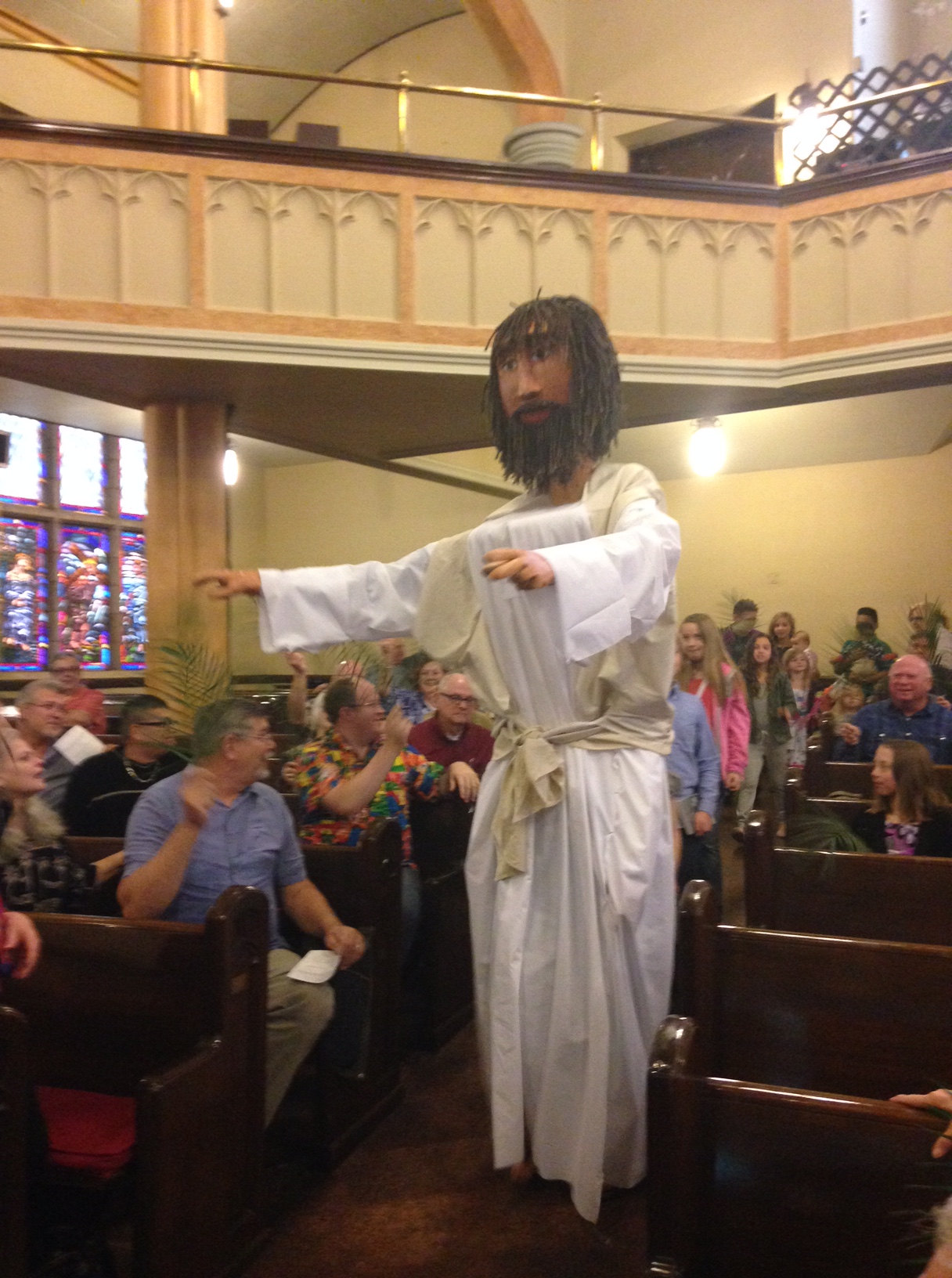
11:1 When they were approaching Jerusalem, at Bethphage and Bethany, near the Mount of Olives, he sent two of his disciples 2 and said to them, “Go into the village ahead of you, and immediately as you enter it, you will find tied there a colt that has never been ridden; untie it and bring it. 3 If anyone says to you, ‘Why are you doing this?’ just say this, ‘The Lord needs it and will send it back here immediately.'” 4 They went away and found a colt tied near a door, outside in the street. As they were untying it, 5 some of the bystanders said to them, “What are you doing, untying the colt?” 6 They told them what Jesus had said; and they allowed them to take it. 7 Then they brought the colt to Jesus and threw their cloaks on it; and he sat on it. 8 Many people spread their cloaks on the road, and others spread leafy branches that they had cut in the fields. 9 Then those who went ahead and those who followed were shouting, “Hosanna! Blessed is the one who comes in the name of the Lord! 10 Blessed is the coming kingdom of our ancestor David! Hosanna in the highest heaven!” 11 Then he entered Jerusalem and went into the temple; and when he had looked around at everything, as it was already late, he went out to Bethany with the twelve.
I don’t know if it’s credit or blame that I deserve for this morning’s giant Jesus puppet. But I didn’t act alone on this deal. Melissa James was my primary co-conspirator. A few of the young people got their hands messy one night. My wife gets all the credit for redeeming his face with paint. Anne Weaver was on board with helping create his robe until she broke her wrist, and I’m so grateful for Brian Minyard’s willingness to be the wearer of the puppet! Next time he’ll know better than to answer a phone call from the preacher on a Saturday morning.
I must say that it was an interesting process for me to try to create a larger-than-life Jesus head. I found a web-site that gave instructions for making a large paper-mache head, and it sort of worked, but it’s not the way I would do it again. The method didn’t lend itself to a well-proportioned head. It made for a large head, and that’s what I was after, but I can tell you that his head was not shaped properly.
It was a good exercise for me to spend time thinking about what Jesus would have looked like. I found myself paying a lot more attention than I normally do to the way people’s heads are shaped. I’m not sure what look I was after, and while I’m sure this is a mangled portrayal of Jesus, you should have seen it before I fixed it. It was much worse early on. I found myself wishing I could create a really handsome Jesus, but that was more about my own vanity than in trying to create the right look for Jesus. From what I can tell, people weren’t drawn to Jesus by his looks. I’m not saying he was unattractive, but it wasn’t his surface appearance that made him so desirable.
I spent a lot of time this last week creating what you might call a mask of Jesus, but I think one way of describing who Jesus was – is to describe him as a man who didn’t wear a mask. Jesus wasn’t someone who pretended to be someone other than himself. He was a bit secretive at times. He didn’t want to be the object of too much attention — particularly in the early days of his ministry, but that was because he knew that crowds of people wouldn’t see him for who he was. Jesus didn’t trust the acclaim that came with fame. He recognized the way in which we often love who we perceive others to be and not who they really are.
Jesus spent much of his time trying to reveal who he was, and who he was not. There was a whole lot of expectation for him to live down, and he did his best to discourage people from following him for the wrong reason. He repeatedly told people to expect hardship if they followed him, but they followed him anyway – not because they understood what he was doing or where he was going but because our illusions of ourselves and of others are hard to destroy.
I had a stray dog come up and visit with me when I was on my bike trip last spring. I was taking a break in the shade in the countryside. There were a few houses here and there, and this dog came up from somewhere and just hung around while I was sitting in the shade. I got ready to go and that dog started following me. I yelled at him a couple of times to go away, but he kept running after me. It was sort of hilly and I would get good distance from him going downhill, but he would gain ground when I started going up hill. It wore me out trying to get away from him, but I finally lost sight of him. Clearly he had no idea where I was going.
I don’t think Jesus tried to shake people the way I tried to shake that dog, but he didn’t just want a bunch of followers. He wanted people to see him for who he was – not for who they wanted him to be.
Until it came time for him to enter Jerusalem – and then he allowed people to simply get excited about his arrival. He knew that there were all kinds of misunderstandings about him, but he didn’t rain on the parade. He accepted the praise of all the people who had no idea who he really was and what he was going to do. You might say he allowed people to put all kinds of masks upon him, but he was never confused about who he was and what he intended to do.
Jesus knew exactly what he was doing when he went along with this crowd that welcomed him in to Jerusalem. The text reveals details about how he had made these very specific plans for his arrival in to Jerusalem. We’re told that he sent two of his disciples in to town to retrieve a colt that no one had ever ridden, and that they were to bring it to him. He told them exactly what to say when someone asked them what they were doing, and it went exactly as he had said it would. Jesus was very clear about what he was doing, and what would transpire.
The fact that they were to get a colt that had never been ridden is a strange little detail. Some speculate that it might have pointed to the ceremonial quality of the animal, but I’m thinking this detail is designed to alert us to the fact that Jesus was about to do something that no one had ever done before. Of course when you get on a colt that’s never been ridden I’m thinking you are introducing a significant variable to the situation. Of course it could be that that colt was the only creature who truly understood what was really going on and he was totally cooperative with Jesus. Sometimes it the non-human animals who are the most sympathetic to what’s going on in our lives.
This was quite a parade that accompanied Jesus in to Jerusalem. Jesus was surrounded by people who had all kinds of agendas, and there’s no indication that there was anyone who truly understood his agenda. I’m guessing most of the people who were ushering him in to town were hoping he was going to spark a revolution and get them out from under Roman occupation. Others were just hoping to get close enough to him to experience one of those miracles they had heard people talking about, and then there would have been others who had never heard of Jesus but were always up for a good mass movement of some kind. Jesus was accompanied by a lot of people, but he might not have ever been more alone.
If you find Palm Sunday to be an emotionally confusing celebration I’m right with you. I’m really not sure how to feel about a day like this. It’s the day we celebrate the dramatic entry of Jesus Christ into Jerusalem, and it’s a painful reminder of how misunderstood Jesus really was. We want to whoop it up for our guy who entered Jerusalem with the means and resolve to change the world, and we now know that it would cost him his life.
It’s not easy to hold together a sense of celebration and sorrow, but I think this passage invites us to embrace both of these emotions on this day we call Palm Sunday. I think it makes sense to have a good time parading a giant Jesus in our sanctuary because we aren’t unlike the people who were excited about the big arrival of Jesus in to Jerusalem. The people who welcomed Jesus in to Jerusalem weren’t being malicious. They were genuinely excited about what they thought he was going to do, and what he was going to do was truly extraordinary – but they had no idea what that was.
The arrival of Jesus in to Jerusalem is something for us to cheer – and to bemoan. It’s an event that is worthy of our gratitude, but it’s also a story that contains a startling revelation. It’s a story that reveals how mistaken our expectations can be, and how costly this journey often is. Following Jesus is not a walk in the park on a sunny spring day.
Today’s story highlights the essence of the struggle we have as Christians. I think we have this desire to be a part of something big and dramatic and powerful and life changing, but the way of discipleship is costly and hard.
We don’t get to wear the masks we like to wear, nor do we get to place the mask on Jesus that will turn him in to the savior we want him to be. Unfortunately we don’t get to create him in the image we prefer. To follow Jesus is to seek to see him for who he is, and to want to be seen for who we are. This can be a frightening undertaking because we can be terribly confused about both Jesus and ourselves, but seeing those truths are the source of our salvation and the avenue to true life.
This story of the way Jesus entered Jerusalem is a story that designed to make us wonder. We don’t know what Jesus was thinking when he walked into the Temple and looked around, but I believe the way this story ends invites us to look around and reflect on who we are and what we are doing.
There is a lot of mystery surrounding the life, death, and resurrection of Jesus, but it’s not that hard to see what Jesus considered to be important. People put a lot of different masks on Jesus, but there was only one real look on his face, and it was the look of a person who loves us all and who challenges us all to love one another. He had the look of undiscriminating love, and that is not a familiar face to any of us. In fact some people feel like their affection for Jesus calls for them to engage in discrimination.
But this story invites us to try to see the ways in which we are blind to the truth about Jesus and ourselves. Jesus isn’t larger than life – Jesus is life, and Jesus wants us to be truly alive as well. I invite you to take a fresh look at who Jesus is and to discover who you really are. Jesus didn’t just want attention – Jesus wanted to be seen for who he was, so that we might see who we can be.
Thanks be to God for the remarkable way God continues to be unmasked before our very eyes. Amen
Lent 5B, March 22, 2015
March 24, 2015
The Unspoken Truth
Jeremiah 31:31-34
31:31 The days are surely coming, says the LORD, when I will make a new covenant with the house of Israel and the house of Judah. 32 It will not be like the covenant that I made with their ancestors when I took them by the hand to bring them out of the land of Egypt–a covenant that they broke, though I was their husband, says the LORD. 33 But this is the covenant that I will make with the house of Israel after those days, says the LORD: I will put my law within them, and I will write it on their hearts; and I will be their God, and they shall be my people. 34 No longer shall they teach one another, or say to each other, “Know the LORD,” for they shall all know me, from the least of them to the greatest, says the LORD; for I will forgive their iniquity, and remember their sin no more.
The prophet Jeremiah lived a tough life. He lived during a difficult period of time for the nation of Israel, and his life was made even more difficult by his compulsion to speak truth to power. At an early age he felt called by God to do this work of exposing the unrighteousness of their nation, and while he initially resisted the prophetic role that God called him to assume, he came to fully embrace it. And he suffered for it. Jeremiah was known for his ability to clearly reveal how the people of Israel were offending God in their personal lives as well as through the public policies of their kings and priests. What Jeremiah had to say was not well received by the various kings that assumed the throne during his long life, and while they never could bring themselves to actually kill him – they didn’t hesitate to have him beaten, imprisoned, and otherwise humiliated.
Jeremiah lived about 6oo years before Jesus was born, and he was living in Judah, the Southern Kingdom of Israel, in 587 BCE when the Babylonians ransacked their country and destroyed the Temple. Jeremiah had seen this coming, and he had offered an avenue for salvation, but neither the people nor the leaders wanted to hear it, and the nation fell. Those were dark days for the people of Israel. The Temple was destroyed, their king and all of the other leaders of their nation were carried off into exile, and it appeared that they had been abandoned by God.
Jeremiah might well have used that occasion to say, I told you so, but that’s not what he chose to do. Jeremiah remained in Judah while the bulk of the population was in exile, but he continued to speak to the people, and he had a new message. The new message was that this experience of destruction and exile was not the consequence of being abandoned by God – it was the beginning of the new way in which God would be present with them. Yes, their circumstance was the consequence of their unfaithful behavior, but their relationship with God was not destroyed. They could learn from what had occurred, and their relationship with God would be enhanced.
That is the context of these words we have from Jeremiah. Jeremiah was writing words of comfort and support to people who’s lives had been totally disrupted and their understanding of God was in question. They considered the Temple to be the place where God was encountered – they considered the Temple to be the dwelling place of God, and the Babylonians had turned it in to a pile of rubble. They weren’t sure what to make of that, and Jeremiah was offering an answer. The Temple was gone, but God was still present. Their leaders were humiliated, but the word of God was still available. In fact, the word of God had become more available to them.
I don’t know about you, but I find these words to be powerfully compelling. I love this idea of God’s word being placed directly inside of our hearts. I’m thinking it’s the first form of direct deposit. It’s not a paycheck that’s being deposited, but God chose to directly deposit this most significant asset directly in to our hearts. And I’m thinking this would have been such good news to these people who were accustomed to their wellbeing being brokered by this institution that had totally crumbled. It would have given them hope for a new future.
It wasn’t a guarantee for a new and successful future, but it revealed the possibility for a new way of living in relationship with God, and even though they often strayed from living in a faithful relationship with God – the people of Israel believed that their wellbeing was in the hands of God.
It was a huge tragedy, but in some ways, this national catastrophe was a levelling event for the people of Israel. It removed the necessity of a qualified agent to stand between God and God’s people.
This may not have been good news to the class of people who held the priestly franchise, but they weren’t really in a good position to dispute these good words from Jeremiah. He was providing an interpretation of what happened that made sense and he was offering hope for the present and the future. They were in a horrible circumstance, but Jeremiah was saying that God was with them where they were.
Having personal access to God’s instruction is a great gift to us all, but that doesn’t mean we always know what to do with it. Just because you have something doesn’t mean you know how to use it. We can use good tools really dangerously.
For some reason this text reminded me of an experience I had with a tennis racquet one time. I’ve never been much of a tennis player, but I used to go out and play occasionally. I’m much better at hitting stationary objects than I am at hitting things that are coming at me quickly, so I’ve just never really embraced tennis. But I go along with other people who want to play, and I was out with some family members one summer morning at a tennis court. We had finished playing, and I started hitting the ball straight up in the air. I kept trying to hit it higher and higher, and I was getting some good attention, so I was swinging harder and harder, and it culminated in a swing that was so hard I couldn’t stop the racquet before I hit myself in the head with it.
I didn’t pass out immediately, but I knew I had taken a significant blow. I put my hands to my head to stop the bleeding, and I kept them there until I got to a nearby bathroom where a Dr. friend was also on hand. He had me remove my hands from my head, and as soon as I saw the knot and the blood I immediately passed out.
I’m the only person I’ve ever known who has knocked their-self out. I don’t guess if was technically a knock-out blow, but it was close.
I think the thing that story illustrates to me is how unaware I was of what I was doing – and the dangerous trajectory my actions had placed me upon. As far as I know, there haven’t been any lasting consequences of that stiff blow to my head, but you never know about such things. That actually could explain a lot about what I’m inclined to do and not do.
But I think we are often unaware of the trajectories of our lives. God has placed some divine wisdom within each of us, but it’s not unusual for us to engage in some personal foolishness – and I’m not just talking about doing stupid things with tennis racquets. The really unfortunate things we do have more to do with ignoring the plight of the poor, advancing initiatives that serve ourselves, getting overly focused on things that don’t matter, and glossing over the things that do.
I’m not convinced that the words of the Prophet Jeremiah would be any more welcomed here in Arkansas right now than they were in Judah before the fall of the Temple. In fact just as Jeremiah was blamed by the false prophets of his day for being discouraging to the people, and I’m guessing he would be accused of doing the same for us.
Prophets are never well regarded by the communities that they serve. And even though Jeremiah was seen as someone who was bringing an ominous forecast to the people of Judah – he was trying to be helpful. He was viewed as a troublemaker because he wasn’t saying what people wanted to hear, but they would have been far better off if they had listened to what he had to say.
I might not have listened if someone had told me I was going to hit myself in the head if I kept doing what I was doing. It may be that I had to actually do what I did before I would believe it, but I sure would have been inclined to listen to what they had to say afterward.
And that’s the way the people of Israel felt about Jeremiah when they found themselves in Babylon without a king or a temple. They had lost what they thought they needed, but it turns out they still had what they really needed. And so do we.
There are always a lot of things that are not going the way we want them to. We could each generate a pretty good list of the things we don’t consider to be going well on so many different levels. It’s hard to watch a developing disaster and feel helpless to stop it. It’s important to try to bring attention to the situations we believe to be wrong, and I thank God for those people who do the heroic work of speaking truth in situations where it would be easier to remain silent.
It’s hard to speak up when it’s easier to go quietly along with whatever is happening. It’s hard to speak up when you know your perspective won’t be appreciated, but the truth is never contained forever. And it’s always a good thing to aspire to be associated with the truth. There are people who do a good job of keeping the truth contained, and sometimes we get confused about what is true and what is convenient, but you can’t silence the One who is still able to make those direct deposits of truth within our hearts.
God’s truth will always emerge, and God’s people will always find comfort in this reality. We might not be where we want to be when we experience that truth, but God’s willingness to be with us wherever we find ourselves to be will always be good news.
Thanks be to God.
Amen.
Lent 4B, March 15, 2015
March 17, 2015
Believing Out Loud
John 3:14-21
3:14 And just as Moses lifted up the serpent in the wilderness, so must the Son of Man be lifted up, 15 that whoever believes in him may have eternal life. 16 “For God so loved the world that he gave his only Son, so that everyone who believes in him may not perish but may have eternal life. 17 “Indeed, God did not send the Son into the world to condemn the world, but in order that the world might be saved through him. 18 Those who believe in him are not condemned; but those who do not believe are condemned already, because they have not believed in the name of the only Son of God. 19 And this is the judgment, that the light has come into the world, and people loved darkness rather than light because their deeds were evil. 20 For all who do evil hate the light and do not come to the light, so that their deeds may not be exposed. 21 But those who do what is true come to the light, so that it may be clearly seen that their deeds have been done in God.”
This reference to Moses lifting a bronze serpent in the wilderness isn’t one of those Old Testament stories that we 21st Century Christians give much attention, but it seems to have been an important image to our early Christian ancestors – particularly our ancestors who were Jewish before they were Christian. Those early Jewish followers of Jesus were much more familiar with these stories from the Torah, and this story about Moses lifting the bronze serpent in the wilderness would have been a story they knew well. It was their version of Snakes on a Plane. Of course they would have referred to it as the story of the snakes on the plain.
The story is that the people of Israel were growing tired of eating manna and quail every day out in the wilderness and thy started complaining about the situation God had put them in. They were talking about how much better they had it while they were back in Egypt, and God responded to their complaining by sending them a bunch of snakes. I don’t guess there’s anything that gets our attention quicker than a bunch of snakes. People went from complaining to begging Moses for relief, and with that God instructed Moses to fashion a bronze serpent on a pole and to lift it up for people to see. When people viewed the bronze serpent on the pole they were healed of their snake bites and they lived.
It’s an unusual story, and while it raises a few questions about God’s sensibilities it’s ultimately a story of how God provided for the wellbeing of the people of Israel while they were in the wilderness. It’s a story about how God once again rescued the Israelites from death.
Looking at a bronze serpent lifted up on a pole isn’t a particularly appealing thing to do, but it was a life-saving thing to do, and John found some kinship between that faith experience, and this new thing that had happened with Jesus. Jesus had been lifted up on a cross which was a terrifying form of death, but for John, that image had become transformed into a symbol of the life-giving power of Jesus.
I mentioned last week of how I’ve become convinced of the deeply Jewish roots of the Book of John. My perspective has been greatly influenced by this book I’m reading that was written by this retired Episcopalean bishop, John Shelby Spong, who puts forth the argument that the Book of John articulates the experience of early Jews who were rejected by the mainstream Jewish community because of their faith in Jesus. And their experience was of finding true life through this man who was killed in that horrific manner. What was intended to be the ultimate form of humiliation, rejection, and defeat had for them become the most glorious moment of Jesus Christ’s life. By going to the cross Jesus had shown them that true life was not found through self-preservation, but through self-giving love, and they embraced this image of Jesus being lifted up on a cross.
John is the only Gospel-writer who made this connection between Jesus being lifted up on a cross and Moses lifting the serpent in the wilderness. It’s a unique comparison, but there’s a powerful message here as well, and I think it was a particularly rich comparison for those early Jewish followers of Jesus. In fact I’m thinking they probably saw a bit of contrast between what Moses provided and what Jesus provides. While Moses provided a way to prevent the death of the Israelites while they were in the wilderness, what Jesus provided is far more than the prevention of death – Jesus provided access to eternal life.
The early Jewish followers of Jesus fully embraced their spiritual history, but they placed their spiritual future in the hands of Jesus – who they saw as the culminating gift of God to the people of Israel. Which is so well articulated in this wildly familiar verse: John 3:16 For God so loved the world that he gave his only Son, so that everyone who believes in him may not perish but may have eternal life.
This is a beautiful verse of scripture. It’s a wonderful verse of scripture, but in some ways it has the power of a worn out bumper sticker. It’s been overused – maybe even abused. You don’t see as many of the giant John 3:16 posters in the end-zones of football games during field goals or extra-point attempts as you used to, but this passage has been highly utilized by people who portray Christianity in a manner that sort of puts me off.
I don’t really know how to expose the inappropriate way that verse has been used. It’s more of a feeling that I have about the way it’s been used than I know how to describe it’s misuse, but I feel that it has often been used to oversimplify the long and rich relationship that has been going on between God and the world since the beginning of time. It’s probably not very helpful for me to tear down what has meaning for someone else, but I also think this verse has been used to define who is right with God and who isn’t. Some would use this verse to divide the world between the believers and the losers, and I don’t think this is what John intended.
This extended passage does get in to this reality of people not being right with God, but such judgment has far more to do with what we focus upon than how God chooses to see us. It’s not God that cuts us off, but it is possible for us to choose to live in darkness rather than in light.
Many Christians would say that our access to eternal life depends upon our belief in Jesus, and I won’t necessarily argue with that premise, but I will argue that it makes a huge difference how you define believing in Jesus and how you understand the concept of eternal life. And it seems to me that the way John understood the concepts of believing in Jesus and finding eternal life are far different from the way we are often inclined to define them.
We often equate believing with giving our mental approval of something, but I don’t think that’s what it meant for John. For John, believing in Jesus wasn’t just a matter of belonging to a particular group of people who were affiliated with Jesus. John portrays believing in Jesus as an act of trusting in the way that Jesus lived, of rejecting the dark forces that put Jesus to death, and of embracing his self-giving manner of loving other people. To believe in Jesus is to believe that you can find your way to God in the midst of any kind of trial or tribulation, and it calls for us to deal with our trials and tribulations in a very particular way.
Believing in Jesus is an act of defiance to whatever powerfully dark forces may be at work in the world, but that same belief requires us to reject those dark forces with love in our hearts – which is the hard part.
There’s a great interdenominational campaign going on that’s called Believe Out Loud. It’s sort of an online movement that seeks to give voice and encouragement to Christians who have non-traditional sexual orientations. There are people around here who wear believe our loud buttons. It’s a phrase that serves to remind us of the importance of giving voice and power to people who have been marginalized by traditional Christianity. I think the book of John speaks to the importance of believing out loud because believing isn’t a quiet undertaking.
But God’s love is always more challenging than we want it to be, and I was reminded of that by an essay I read on the progressive Christian website called Patheos.com. The essay was written by a professor at SMU named Dr. Maria Dixon. In addition to several other degrees, Dr. Dixon has a Master of Divinity from Candler School of Theology, but she teaches in the field of communication, and she is very familiar with the landscape of undergraduate misbehavior.
Dr. Dixon is an African American woman, and she wrote an essay about the ugly incident involving the fraternity pledges at the University of Oklahoma. If you don’t know what I’m talking about consider yourself lucky, but there is this video of these young white men – she would call them pre-adults, singing a horribly racist song on a bus, and Dr. Dixon didn’t like the way the school officials handled the situation. She didn’t take issue with the outrage they expressed, but she didn’t think total rejection was the most helpful thing to do.
She wrote a great essay about what she thought could have happened to turn the situation in to more of a teachable moment, but she also owned up to the unlikeliness of such a thing happening. She concluded her essay with the following paragraph:
Look, I know it is easier just to be done with these students. Bashing them is incredibly popular and dismissing them from the island of humanity appears to be all the rage. Unfortunately, I am called to the two most idealistic professions—teaching and preaching and I believe in the power of conversion. I believe in the power of Grace. I believe in a God of Second Chances. I believe in a God who is a master teacher.
Her essay reminded me that this business of believing out loud is a perpetual challenge to our pre-perfect souls. Just when we think we know who the enemy is and what we need to do to them – we get a glimpse of the one who chose to be lifted on a cross so that we could see what love really looks like and how to obtain true life.
To believe in Jesus is to believe out loud that there’s hope for us all. We are called to boldly resist the dark forces that are at work in our world, but probably our largest challenge is to resist the endless forms of darkness that we are each tempted to embrace. Living in the light has always been a challenge, and it always will be, but God has provided us with a great gift. For God so loved the world God didn’t send more snakes to get our attention – God gave us Jesus, and if we will truly believe in him we will find our way into the light and experience this gift of abundant life.
Thanks be to God.
Amen.
 Thompson's Blog